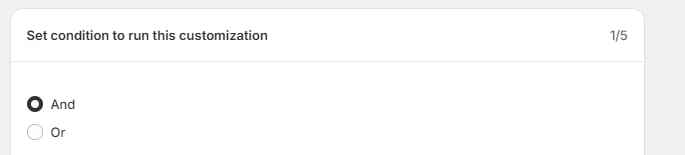
Listing alternatives — several countries, several currencies, several tags → Or
Narrowing to a case — a specific combination of circumstances → And
A useful check: read the right-hand Description panel aloud. It prints the joiner as a badge between conditions. If the sentence sounds right, the rule is right.
There is one joiner per rule. You cannot express (A or B) and C in a single advanced customization.
Two ways around it:Split into several rules.(Germany or Austria) and cart over ₹10,000 becomes two rules — one for Germany, one for Austria, each with the cart-total condition. Rules are independent, so two rules hiding the same method behave as an Or between them.Use a sub-condition. Sub-conditions refine their parent condition rather than joining the top-level group, which covers many cases that look like they need mixed logic — narrowing Cart contains products by collection or vendor, for example, instead of adding a second top-level condition.
Rules do not know about each other. Every active rule is evaluated, and a method hidden by any one of them is hidden. This is why splitting works — and why an unexpectedly missing payment method is usually a second, forgotten rule rather than a bug in the one you are looking at. Check the full customizations list before assuming.
{"docsConfig":{"theme":"mint","$schema":"https://mintlify.com/docs.json","name":"Codebeans Payment Rules Pro","colors":{"primary":"#275A89","light":"#BCF5F1","dark":"#1D4670"},"logo":{"light":"https://mintcdn.com/codebeans-payment-rules-pro/0guf-DxrSbw6Ls57/logo/icon.png?fit=max\u0026auto=format\u0026n=0guf-DxrSbw6Ls57\u0026q=85\u0026s=3339fca66013b33dfbdfeee698d3da0d","dark":"https://mintcdn.com/codebeans-payment-rules-pro/0guf-DxrSbw6Ls57/logo/icon.png?fit=max\u0026auto=format\u0026n=0guf-DxrSbw6Ls57\u0026q=85\u0026s=3339fca66013b33dfbdfeee698d3da0d"},"favicon":"https://mintcdn.com/codebeans-payment-rules-pro/0guf-DxrSbw6Ls57/logo/icon.png?fit=max\u0026auto=format\u0026n=0guf-DxrSbw6Ls57\u0026q=85\u0026s=3339fca66013b33dfbdfeee698d3da0d","navbar":{"primary":{"type":"button","label":"Contact support","href":"mailto:support@codebeans.net"}},"footer":{"socials":{"website":"https://codebeans.net"}},"styling":{"latex":false},"navigation":{"pages":[]}},"deployment":{"deploymentMetadataValue":{"subdomain":"codebeans-payment-rules-pro","hasAudioNarration":false,"actualSubdomain":"codebeans-payment-rules-pro","customDomains":[],"gitSource":{"type":"github","owner":"codebeans-shopify","repo":"shopy-advance-payment-rules","deployBranch":"mintlify-main","contentDirectory":"","isPrivate":true,"mountPath":"","label":""},"entitlements":{"AI_CHAT":{"status":"DISABLED"},"WEB_MCP":{"status":"DISABLED"},"NARRATION":{"status":"DISABLED"}},"buildId":"6ad212246556cd470becf411","clientVersion":"0.0.4094","searchFilterCounts":[{"language":"default","tag":"Getting Started","count":4},{"language":"default","tag":"Payments Organizers","count":4},{"language":"default","tag":"Reference","count":4},{"language":"default","tag":"Conditions \u0026 Actions","count":3},{"language":"default","tag":"Managing Rules","count":3},{"language":"default","tag":"Rule Types","count":3},{"language":"default","tag":"Your Payment Methods","count":2}]},"assistantConfig":{"enableAskAiButton":false,"enableStarterQuestions":false,"enableContextualStarterQuestions":false,"enableAskAiSearchBar":true},"basePath":"","hasChatPermissions":false,"hasWebMcpPermissions":false,"toggles":[{"name":"kill-isr","enabled":true,"variant":{"name":"disabled","enabled":false,"feature_enabled":true},"impressionData":false},{"name":"custom-rbac-roles","enabled":true,"variant":{"name":"disabled","enabled":false,"feature_enabled":true},"impressionData":false},{"name":"agent-mintlify-slack","enabled":true,"variant":{"name":"disabled","enabled":false,"feature_enabled":true},"impressionData":false},{"name":"agent-integrations-settings","enabled":true,"variant":{"name":"disabled","enabled":false,"feature_enabled":true},"impressionData":false},{"name":"rbac-expansion","enabled":true,"variant":{"name":"disabled","enabled":false,"feature_enabled":true},"impressionData":false},{"name":"automations-pr-grouping","enabled":true,"variant":{"name":"disabled","enabled":false,"feature_enabled":true},"impressionData":false},{"name":"custom-prefix","enabled":true,"variant":{"name":"disabled","enabled":false,"feature_enabled":true},"impressionData":false},{"name":"analytics-v7","enabled":true,"variant":{"name":"disabled","enabled":false,"feature_enabled":true},"impressionData":false},{"name":"user-flows-analytics","enabled":true,"variant":{"name":"disabled","enabled":false,"feature_enabled":true},"impressionData":false},{"name":"no-publish-flow","enabled":true,"variant":{"name":"disabled","enabled":false,"feature_enabled":true},"impressionData":false},{"name":"workos-onboarding","enabled":true,"variant":{"name":"disabled","enabled":false,"feature_enabled":true},"impressionData":false},{"name":"llms-txt-v2","enabled":true,"variant":{"name":"disabled","enabled":false,"feature_enabled":true},"impressionData":false},{"name":"snapshot-serving-live","enabled":true,"variant":{"name":"disabled","enabled":false,"feature_enabled":true},"impressionData":false},{"name":"stripTemperatureMiddleware","enabled":true,"variant":{"name":"disabled","enabled":false,"feature_enabled":true},"impressionData":false},{"name":"support-platform-pylon-zendesk","enabled":true,"variant":{"name":"disabled","enabled":false,"feature_enabled":true},"impressionData":false},{"name":"snapshot-serving","enabled":true,"variant":{"name":"disabled","enabled":false,"feature_enabled":true},"impressionData":false},{"name":"instant-rollback","enabled":true,"variant":{"name":"disabled","enabled":false,"feature_enabled":true},"impressionData":false},{"name":"granular-notifications-server","enabled":true,"variant":{"name":"disabled","enabled":false,"feature_enabled":true},"impressionData":false},{"name":"granular-notifications","enabled":true,"variant":{"name":"disabled","enabled":false,"feature_enabled":true},"impressionData":false},{"name":"automations-fable","enabled":true,"variant":{"name":"disabled","enabled":false,"feature_enabled":true},"impressionData":false},{"name":"fixed-ai-action-pricing","enabled":true,"variant":{"name":"disabled","enabled":false,"feature_enabled":true},"impressionData":false},{"name":"automation-resolve-merge-conflict","enabled":true,"variant":{"name":"disabled","enabled":false,"feature_enabled":true},"impressionData":false},{"name":"scoped-publishing","enabled":true,"variant":{"name":"disabled","enabled":false,"feature_enabled":true},"impressionData":false},{"name":"mintql","enabled":true,"variant":{"name":"disabled","enabled":false,"feature_enabled":true},"impressionData":false},{"name":"page-level-analytics","enabled":true,"variant":{"name":"disabled","enabled":false,"feature_enabled":true},"impressionData":false},{"name":"editor-version-history-v2","enabled":true,"variant":{"name":"disabled","enabled":false,"feature_enabled":true},"impressionData":false},{"name":"billing-page-v2","enabled":true,"variant":{"name":"disabled","enabled":false,"feature_enabled":true},"impressionData":false},{"name":"full-page-search","enabled":true,"variant":{"name":"disabled","enabled":false,"feature_enabled":true},"impressionData":false},{"name":"workspace-projects","enabled":true,"variant":{"name":"disabled","enabled":false,"feature_enabled":true},"impressionData":false},{"name":"assistant-v5","enabled":true,"variant":{"name":"disabled","enabled":false,"feature_enabled":true},"impressionData":false},{"name":"fork-pr-previews","enabled":true,"variant":{"name":"disabled","enabled":false,"feature_enabled":true},"impressionData":false},{"name":"revalidation-jwt","enabled":true,"variant":{"name":"disabled","enabled":false,"feature_enabled":true},"impressionData":false},{"name":"workos-sso-scim","enabled":true,"variant":{"name":"disabled","enabled":false,"feature_enabled":true},"impressionData":false},{"name":"hobby-abuse-scan","enabled":true,"variant":{"name":"disabled","enabled":false,"feature_enabled":true},"impressionData":false},{"name":"dashboard-inbox","enabled":true,"variant":{"name":"disabled","enabled":false,"feature_enabled":true},"impressionData":false},{"name":"workos-signup","enabled":true,"variant":{"name":"disabled","enabled":false,"feature_enabled":true},"impressionData":false},{"name":"turbopuffer-dual-write","enabled":true,"variant":{"name":"disabled","enabled":false,"feature_enabled":true},"impressionData":false},{"name":"workos-enabled","enabled":true,"variant":{"name":"disabled","enabled":false,"feature_enabled":true},"impressionData":false},{"name":"approve-review-flow","enabled":true,"variant":{"name":"disabled","enabled":false,"feature_enabled":true},"impressionData":false},{"name":"editor-metadata","enabled":true,"variant":{"name":"disabled","enabled":false,"feature_enabled":true},"impressionData":false},{"name":"sso-setup-deadline-banner","enabled":true,"variant":{"name":"disabled","enabled":false,"feature_enabled":true},"impressionData":false},{"name":"turbopuffer-serve","enabled":true,"variant":{"name":"disabled","enabled":false,"feature_enabled":true},"impressionData":false},{"name":"live-agents","enabled":true,"variant":{"name":"disabled","enabled":false,"feature_enabled":true},"impressionData":false}],"googleFontsInlined":false},"customCss":[],"page":{"pagePath":"conditions-and-actions/and-or","slug":"/conditions-and-actions/and-or","pageMetadata":{"title":"Combining conditions with And / Or","description":"How the joiner changes what your rule matches, and what to do when you need both.","icon":"code-branch","href":"/conditions-and-actions/and-or"},"description":{"compiledSource":"\"use strict\";\nconst {jsx: _jsx} = arguments[0];\nconst {useMDXComponents: _provideComponents} = arguments[0];\nfunction _createMdxContent(props) {\n const _components = {\n p: \"p\",\n ..._provideComponents(),\n ...props.components\n };\n return _jsx(_components.p, {\n children: \"How the joiner changes what your rule matches, and what to do when you need both.\"\n });\n}\nfunction MDXContent(props = {}) {\n const {wrapper: MDXLayout} = {\n ..._provideComponents(),\n ...props.components\n };\n return MDXLayout ? _jsx(MDXLayout, {\n ...props,\n children: _jsx(_createMdxContent, {\n ...props\n })\n }) : _createMdxContent(props);\n}\nreturn {\n default: MDXContent\n};\n","frontmatter":{},"scope":{}},"pageType":"default","mdx":{"mdxSource":{"compiledSource":"\"use strict\";const{Fragment:_Fragment,jsx:_jsx,jsxs:_jsxs}=arguments[0];const{useMDXComponents:_provideComponents}=arguments[0];function _createMdxContent(props){const _components={a:`a`,blockquote:`blockquote`,em:`em`,li:`li`,p:`p`,strong:`strong`,ul:`ul`,..._provideComponents(),...props.components},{Heading,OptimizedImage,Warning}=_components;if(!Heading)_missingMdxReference(`Heading`,true);if(!OptimizedImage)_missingMdxReference(`OptimizedImage`,true);if(!Warning)_missingMdxReference(`Warning`,true);return _jsxs(_Fragment,{children:[_jsxs(_components.p,{children:[`Advanced customizations hold up to five conditions, joined by a single `,_jsx(_components.strong,{children:`And`}),` / `,_jsx(_components.strong,{children:`Or`}),` selector that applies to all of them.`]}),`\n`,_jsx(OptimizedImage,{src:`https://mintcdn.com/codebeans-payment-rules-pro/0guf-DxrSbw6Ls57/images/advanced-conditions.jpg?fit=max\u0026auto=format\u0026n=0guf-DxrSbw6Ls57\u0026q=85\u0026s=95eafad3416d3447c808767adfc3dd81`,alt:`The And / Or radios above the condition group`,\"data-og-width\":`685`,width:`685`,\"data-og-height\":`155`,height:`155`,\"data-path\":`images/advanced-conditions.jpg`,\"data-optimize\":`true`,\"data-opv\":`3`,srcset:`https://mintcdn.com/codebeans-payment-rules-pro/0guf-DxrSbw6Ls57/images/advanced-conditions.jpg?w=280\u0026fit=max\u0026auto=format\u0026n=0guf-DxrSbw6Ls57\u0026q=85\u0026s=0237c601573785154cd7c12bb3c5d201 280w, https://mintcdn.com/codebeans-payment-rules-pro/0guf-DxrSbw6Ls57/images/advanced-conditions.jpg?w=560\u0026fit=max\u0026auto=format\u0026n=0guf-DxrSbw6Ls57\u0026q=85\u0026s=f61072a15e29e04e0c93554034b10551 560w, https://mintcdn.com/codebeans-payment-rules-pro/0guf-DxrSbw6Ls57/images/advanced-conditions.jpg?w=840\u0026fit=max\u0026auto=format\u0026n=0guf-DxrSbw6Ls57\u0026q=85\u0026s=14aca67e8603046cb8506db272e71aed 840w, https://mintcdn.com/codebeans-payment-rules-pro/0guf-DxrSbw6Ls57/images/advanced-conditions.jpg?w=1100\u0026fit=max\u0026auto=format\u0026n=0guf-DxrSbw6Ls57\u0026q=85\u0026s=0e9eb39611c2018c32b349cc6480aa16 1100w, https://mintcdn.com/codebeans-payment-rules-pro/0guf-DxrSbw6Ls57/images/advanced-conditions.jpg?w=1650\u0026fit=max\u0026auto=format\u0026n=0guf-DxrSbw6Ls57\u0026q=85\u0026s=7db9d64f1c6d241768222c092750a41c 1650w, https://mintcdn.com/codebeans-payment-rules-pro/0guf-DxrSbw6Ls57/images/advanced-conditions.jpg?w=2500\u0026fit=max\u0026auto=format\u0026n=0guf-DxrSbw6Ls57\u0026q=85\u0026s=47700ef0d9878436403f1520b3c2945b 2500w`}),`\n`,_jsx(Heading,{level:`2`,id:`the-two-joiners`,children:`The two joiners`}),`\n`,_jsxs(_components.p,{children:[_jsx(_components.strong,{children:`And`}),` — every condition must be true. Each condition you add makes the rule fire `,_jsx(_components.em,{children:`less`}),` often.`]}),`\n`,_jsxs(_components.blockquote,{children:[`\n`,_jsxs(_components.p,{children:[`Cart total over ₹10,000 `,_jsx(_components.strong,{children:`and`}),` shipping to Germany `,_jsx(_components.strong,{children:`and`}),` customer not logged in`]}),`\n`]}),`\n`,_jsxs(_components.p,{children:[_jsx(_components.strong,{children:`Or`}),` — one true condition is enough. Each condition makes the rule fire `,_jsx(_components.em,{children:`more`}),` often.`]}),`\n`,_jsxs(_components.blockquote,{children:[`\n`,_jsxs(_components.p,{children:[`Currency is USD `,_jsx(_components.strong,{children:`or`}),` currency is CAD `,_jsx(_components.strong,{children:`or`}),` currency is AUD`]}),`\n`]}),`\n`,_jsx(Heading,{level:`2`,id:`choosing-between-them`,children:`Choosing between them`}),`\n`,_jsx(_components.p,{children:`The joiner follows from the shape of your intent:`}),`\n`,_jsxs(_components.ul,{children:[`\n`,_jsxs(_components.li,{children:[_jsx(_components.strong,{children:`Listing alternatives`}),` — several countries, several currencies, several tags → `,_jsx(_components.strong,{children:`Or`})]}),`\n`,_jsxs(_components.li,{children:[_jsx(_components.strong,{children:`Narrowing to a case`}),` — a specific combination of circumstances → `,_jsx(_components.strong,{children:`And`})]}),`\n`]}),`\n`,_jsxs(_components.p,{children:[`A useful check: read the right-hand `,_jsx(_components.strong,{children:`Description`}),` panel aloud. It prints the joiner as a badge between conditions. If the sentence sounds right, the rule is right.`]}),`\n`,_jsx(Heading,{level:`2`,id:`the-mixed-logic-limit`,children:`The mixed-logic limit`}),`\n`,_jsx(Warning,{children:_jsxs(_components.p,{children:[`There is one joiner per rule. You cannot express `,_jsx(_components.em,{children:`(A or B) and C`}),` in a single advanced customization.`]})}),`\n`,_jsx(_components.p,{children:`Two ways around it:`}),`\n`,_jsxs(_components.p,{children:[_jsx(_components.strong,{children:`Split into several rules.`}),` `,_jsx(_components.em,{children:`(Germany or Austria) and cart over ₹10,000`}),` becomes two rules — one for Germany, one for Austria, each with the cart-total condition. Rules are independent, so two rules hiding the same method behave as an Or between them.`]}),`\n`,_jsxs(_components.p,{children:[_jsx(_components.strong,{children:`Use a sub-condition.`}),` Sub-conditions refine their parent condition rather than joining the top-level group, which covers many cases that look like they need mixed logic — narrowing `,_jsx(_components.em,{children:`Cart contains products`}),` by collection or vendor, for example, instead of adding a second top-level condition.`]}),`\n`,_jsx(Heading,{level:`2`,id:`multiple-rules-interact`,children:`Multiple rules interact`}),`\n`,_jsxs(_components.p,{children:[`Rules do not know about each other. Every active rule is evaluated, and a method hidden by any one of them is hidden. This is why splitting works — and why an unexpectedly missing payment method is usually a second, forgotten rule rather than a bug in the one you are looking at. Check the full `,_jsx(_components.a,{href:`/your-payment-methods/the-customizations-list`,children:`customizations list`}),` before assuming.`]})]})}function MDXContent(props={}){const{wrapper:MDXLayout}={..._provideComponents(),...props.components};return MDXLayout?_jsx(MDXLayout,{...props,children:_jsx(_createMdxContent,{...props})}):_createMdxContent(props)}return{default:MDXContent};function _missingMdxReference(id,component){throw new Error(`Expected `+(component?`component`:`object`)+\" `\"+id+\"` to be defined: you likely forgot to import, pass, or provide it.\")}","frontmatter":{},"scope":{"config":{},"pageMetadata":{"title":"Combining conditions with And / Or","description":"How the joiner changes what your rule matches, and what to do when you need both.","icon":"code-branch","href":"/conditions-and-actions/and-or"}}},"mdxSourceWithNoJs":null},"mdxExtracts":{"tableOfContents":[{"title":"The two joiners","slug":"the-two-joiners","depth":2,"children":[]},{"title":"Choosing between them","slug":"choosing-between-them","depth":2,"children":[]},{"title":"The mixed-logic limit","slug":"the-mixed-logic-limit","depth":2,"children":[]},{"title":"Multiple rules interact","slug":"multiple-rules-interact","depth":2,"children":[]}],"codeExamples":{}},"jsLinks":[],"subdomain":"codebeans-payment-rules-pro","siteName":"Codebeans Payment Rules Pro","title":"Combining conditions with And / Or - Codebeans Payment Rules Pro","navMaps":{"firstHrefInVersion":{},"firstHrefInLanguage":{}},"lastModified":"2026-10-16T12:01:49.413Z","originalFileLocation":"conditions-and-actions/and-or.mdx"},"headHtml":"\u003cscript data-mint-head>(function(){var d=document.documentElement,p=null;if(!p){try{p=localStorage.getItem(\"isDarkMode\")}catch(e){}if(p==='true')p='dark';else if(p==='false')p='light';if(p!=='light'\u0026\u0026p!=='dark'\u0026\u0026p!=='system')p=\"system\"}var r=p==='system'?(matchMedia(\"(prefers-color-scheme: dark)\").matches?'dark':'light'):p;d.classList.remove(r==='dark'?'light':'dark');d.classList.add(r);d.setAttribute(\"data-theme-preference\",p)})();\u003c/script>\u003cmeta data-mint-head name=\"description\" content=\"How the joiner changes what your rule matches, and what to do when you need both.\">\u003cmeta data-mint-head name=\"application-name\" content=\"Codebeans Payment Rules Pro\">\u003cmeta data-mint-head name=\"generator\" content=\"Mintlify\">\u003clink data-mint-head rel=\"icon\" type=\"image/png\" sizes=\"192x192\" href=\"/mintlify-assets/_mintlify/favicons/codebeans-payment-rules-pro/XMwLUEgC92yShQAu/_generated/favicon/android-chrome-192x192.png\" media=\"(prefers-color-scheme: light)\">\u003clink data-mint-head rel=\"apple-touch-icon\" type=\"image/png\" sizes=\"180x180\" href=\"/mintlify-assets/_mintlify/favicons/codebeans-payment-rules-pro/XMwLUEgC92yShQAu/_generated/favicon/apple-touch-icon.png\">\u003clink data-mint-head rel=\"icon\" type=\"image/png\" sizes=\"16x16\" href=\"/mintlify-assets/_mintlify/favicons/codebeans-payment-rules-pro/XMwLUEgC92yShQAu/_generated/favicon/favicon-16x16.png\" media=\"(prefers-color-scheme: light)\">\u003clink data-mint-head rel=\"icon\" type=\"image/png\" sizes=\"32x32\" href=\"/mintlify-assets/_mintlify/favicons/codebeans-payment-rules-pro/XMwLUEgC92yShQAu/_generated/favicon/favicon-32x32.png\" media=\"(prefers-color-scheme: light)\">\u003clink data-mint-head rel=\"shortcut icon\" type=\"image/x-icon\" href=\"/mintlify-assets/_mintlify/favicons/codebeans-payment-rules-pro/XMwLUEgC92yShQAu/_generated/favicon/favicon.ico\" media=\"(prefers-color-scheme: light)\">\u003clink data-mint-head rel=\"icon\" type=\"image/png\" sizes=\"192x192\" href=\"/mintlify-assets/_mintlify/favicons/codebeans-payment-rules-pro/XMwLUEgC92yShQAu/_generated/favicon-dark/android-chrome-192x192.png\" media=\"(prefers-color-scheme: dark)\">\u003clink data-mint-head rel=\"icon\" type=\"image/png\" sizes=\"16x16\" href=\"/mintlify-assets/_mintlify/favicons/codebeans-payment-rules-pro/XMwLUEgC92yShQAu/_generated/favicon-dark/favicon-16x16.png\" media=\"(prefers-color-scheme: dark)\">\u003clink data-mint-head rel=\"icon\" type=\"image/png\" sizes=\"32x32\" href=\"/mintlify-assets/_mintlify/favicons/codebeans-payment-rules-pro/XMwLUEgC92yShQAu/_generated/favicon-dark/favicon-32x32.png\" media=\"(prefers-color-scheme: dark)\">\u003clink data-mint-head rel=\"shortcut icon\" type=\"image/x-icon\" href=\"/mintlify-assets/_mintlify/favicons/codebeans-payment-rules-pro/XMwLUEgC92yShQAu/_generated/favicon-dark/favicon.ico\" media=\"(prefers-color-scheme: dark)\">\u003cmeta data-mint-head property=\"og:title\" content=\"Combining conditions with And / Or - Codebeans Payment Rules Pro\">\u003cmeta data-mint-head property=\"og:description\" content=\"How the joiner changes what your rule matches, and what to do when you need both.\">\u003cmeta data-mint-head property=\"og:site_name\" content=\"Codebeans Payment Rules Pro\">\u003cmeta data-mint-head property=\"og:url\" content=\"https://codebeans-payment-rules-pro.mintlify.app/conditions-and-actions/and-or\">\u003cmeta data-mint-head property=\"og:type\" content=\"website\">\u003cmeta data-mint-head property=\"og:image\" content=\"https://codebeans-payment-rules-pro.mintlify.site/_mintlify/api/og/v2?division=Conditions+%26+Actions\u0026amp;title=Combining+conditions+with+And+%2F+Or\u0026amp;description=How+the+joiner+changes+what+your+rule+matches%2C+and+what+to+do+when+you+need+both.\u0026amp;theme=ed0efffca89fce5aa70d4022\u0026amp;signature=61359f941772ca4f43cc17a7b4fda4d862dd657f32e4a393fc8fab19d48a4c6e\">\u003cmeta data-mint-head property=\"og:image:width\" content=\"1200\">\u003cmeta data-mint-head property=\"og:image:height\" content=\"630\">\u003cmeta data-mint-head name=\"twitter:card\" content=\"summary_large_image\">\u003cmeta data-mint-head name=\"twitter:title\" content=\"Combining conditions with And / Or - Codebeans Payment Rules Pro\">\u003cmeta data-mint-head name=\"twitter:description\" content=\"How the joiner changes what your rule matches, and what to do when you need both.\">\u003cmeta data-mint-head name=\"twitter:image\" content=\"https://codebeans-payment-rules-pro.mintlify.site/_mintlify/api/og/v2?division=Conditions+%26+Actions\u0026amp;title=Combining+conditions+with+And+%2F+Or\u0026amp;description=How+the+joiner+changes+what+your+rule+matches%2C+and+what+to+do+when+you+need+both.\u0026amp;theme=ed0efffca89fce5aa70d4022\u0026amp;signature=61359f941772ca4f43cc17a7b4fda4d862dd657f32e4a393fc8fab19d48a4c6e\">\u003cmeta data-mint-head name=\"twitter:image:width\" content=\"1200\">\u003cmeta data-mint-head name=\"twitter:image:height\" content=\"630\">\u003cmeta data-mint-head name=\"msapplication-config\" content=\"/mintlify-assets/_mintlify/favicons/codebeans-payment-rules-pro/XMwLUEgC92yShQAu/_generated/favicon/browserconfig.xml\">\u003cmeta data-mint-head name=\"apple-mobile-web-app-title\" content=\"Codebeans Payment Rules Pro\">\u003cmeta data-mint-head name=\"msapplication-TileColor\" content=\"#275A89\">\u003clink data-mint-head rel=\"canonical\" href=\"https://codebeans-payment-rules-pro.mintlify.app/conditions-and-actions/and-or\">\u003clink data-mint-head rel=\"alternate\" type=\"application/xml\" href=\"/sitemap.xml\">\u003clink data-mint-head rel=\"alternate\" type=\"text/markdown\" href=\"/conditions-and-actions/and-or.md\">\u003cscript data-mint-head type=\"application/ld+json\">{\"@context\":\"https://schema.org\",\"@graph\":[{\"@type\":\"Organization\",\"@id\":\"https://codebeans-payment-rules-pro.mintlify.app/#organization\",\"name\":\"Codebeans Payment Rules Pro\",\"url\":\"https://codebeans-payment-rules-pro.mintlify.app\",\"logo\":{\"@type\":\"ImageObject\",\"url\":\"https://mintcdn.com/codebeans-payment-rules-pro/0guf-DxrSbw6Ls57/logo/icon.png?fit=max\u0026auto=format\u0026n=0guf-DxrSbw6Ls57\u0026q=85\u0026s=3339fca66013b33dfbdfeee698d3da0d\"}},{\"@type\":\"WebSite\",\"@id\":\"https://codebeans-payment-rules-pro.mintlify.app#website\",\"name\":\"Codebeans Payment Rules Pro\",\"url\":\"https://codebeans-payment-rules-pro.mintlify.app\",\"publisher\":{\"@id\":\"https://codebeans-payment-rules-pro.mintlify.app/#organization\"}},{\"@type\":\"WebPage\",\"@id\":\"https://codebeans-payment-rules-pro.mintlify.app/conditions-and-actions/and-or#webpage\",\"url\":\"https://codebeans-payment-rules-pro.mintlify.app/conditions-and-actions/and-or\",\"name\":\"Combining conditions with And / Or\",\"description\":\"How the joiner changes what your rule matches, and what to do when you need both.\",\"dateModified\":\"2026-10-16T12:01:49.413Z\",\"isPartOf\":{\"@id\":\"https://codebeans-payment-rules-pro.mintlify.app#website\"},\"breadcrumb\":{\"@id\":\"https://codebeans-payment-rules-pro.mintlify.app/conditions-and-actions/and-or#breadcrumb\"}},{\"@type\":\"BreadcrumbList\",\"@id\":\"https://codebeans-payment-rules-pro.mintlify.app/conditions-and-actions/and-or#breadcrumb\",\"itemListElement\":[{\"@type\":\"ListItem\",\"position\":1,\"name\":\"Conditions \u0026 Actions\",\"item\":\"https://codebeans-payment-rules-pro.mintlify.app/conditions-and-actions/conditions-reference\"},{\"@type\":\"ListItem\",\"position\":2,\"name\":\"Combining conditions with And / Or\",\"item\":\"https://codebeans-payment-rules-pro.mintlify.app/conditions-and-actions/and-or\"}]},{\"@type\":[\"Article\",\"TechArticle\"],\"@id\":\"https://codebeans-payment-rules-pro.mintlify.app/conditions-and-actions/and-or#article\",\"headline\":\"Combining conditions with And / Or\",\"name\":\"Combining conditions with And / Or\",\"description\":\"How the joiner changes what your rule matches, and what to do when you need both.\",\"url\":\"https://codebeans-payment-rules-pro.mintlify.app/conditions-and-actions/and-or\",\"mainEntityOfPage\":{\"@id\":\"https://codebeans-payment-rules-pro.mintlify.app/conditions-and-actions/and-or#webpage\"},\"dateModified\":\"2026-10-16T12:01:49.413Z\",\"publisher\":{\"@id\":\"https://codebeans-payment-rules-pro.mintlify.app/#organization\"},\"isPartOf\":{\"@id\":\"https://codebeans-payment-rules-pro.mintlify.app#website\"}}]}\u003c/script>\u003cscript data-mint-head type=\"application/ld+json\">{\"@context\":\"https://schema.org\",\"@type\":\"WebSite\",\"name\":\"Codebeans Payment Rules Pro\",\"creator\":{\"@type\":\"Organization\",\"name\":\"Mintlify\",\"url\":\"https://mintlify.com\"}}\u003c/script>","siteName":"Codebeans Payment Rules Pro","nav":{"global":null,"groups":[{"group":"Getting Started","pages":[{"title":"Introduction","icon":"hand-wave","href":"/index"},{"title":"Installing the app and choosing a plan","icon":"download","href":"/getting-started/installing-and-choosing-a-plan"},{"title":"Understanding the Home page","icon":"house","href":"/getting-started/understanding-the-home-page"},{"title":"Finding your way around","icon":"compass","href":"/getting-started/finding-your-way-around"}]},{"group":"Your Payment Methods","pages":[{"title":"How payment customizations work","icon":"gears","href":"/your-payment-methods/how-payment-customizations-work"},{"title":"The customizations list","icon":"list","href":"/your-payment-methods/the-customizations-list"}]},{"group":"Rule Types","pages":[{"title":"Choosing a rule type","icon":"signs-post","href":"/rule-types/choosing-a-rule-type"},{"title":"Simple customization","icon":"wand-magic-sparkles","href":"/rule-types/simple-customization"},{"title":"Advanced customization","icon":"sliders","href":"/rule-types/advanced-customization"}]},{"group":"Payments Organizers","pages":[{"title":"Country Payments Organizer","icon":"earth-americas","href":"/payments-organizers/country-payments-organizer"},{"title":"Shopify Market Payments Organizer","icon":"globe","href":"/payments-organizers/shopify-market-payments-organizer"},{"title":"Customer Tag Payments Organizer","icon":"tag","href":"/payments-organizers/customer-tag-payments-organizer"},{"title":"Customer Company Payments Organizer","icon":"building","href":"/payments-organizers/customer-company-payments-organizer"}]},{"group":"Conditions \u0026 Actions","pages":[{"title":"Conditions reference","description":"Every condition and operator the app offers, by section.","icon":"book","href":"/conditions-and-actions/conditions-reference"},{"title":"Combining conditions with And / Or","icon":"code-branch","href":"/conditions-and-actions/and-or"},{"title":"Hide, sort and rename","description":"The three things a rule can do to a payment method, and how to set them per method.","icon":"eye-slash","href":"/conditions-and-actions/hide-sort-rename"}]},{"group":"Managing Rules","pages":[{"title":"Turning rules on and off","icon":"toggle-on","href":"/managing-rules/turning-rules-on-and-off"},{"title":"Import and export","icon":"file-import","href":"/managing-rules/import-and-export"},{"title":"Deleting a rule","icon":"trash","href":"/managing-rules/deleting-a-rule"}]},{"group":"Reference","pages":[{"title":"Common questions","icon":"circle-question","href":"/reference/common-questions"},{"title":"Troubleshooting","icon":"screwdriver-wrench","href":"/reference/troubleshooting"},{"title":"Getting help","icon":"life-ring","href":"/reference/getting-help"},{"title":"A suggested setup order","icon":"list-ol","href":"/reference/a-suggested-setup-order"}]}]},"basePath":"","title":"Combining conditions with And / Or - Codebeans Payment Rules Pro","buildId":"dpl_42LwxxU1kGN114H4XzwGYXa9ZDah","deploymentId":"dpl_42LwxxU1kGN114H4XzwGYXa9ZDah","dynamics":["a74be98ba7"],"chunks":["zoom-image-lightbox-DkE6VzSN.js","lightbox-handle-r17bVUz3.js"]}